Tuesday, January 27, 2009

Key Features of Mobile Marketing

Wireless phone services have long been a favored tool for communication but have only recently been favored as a marketing opportunity. Mobile devices enable brands to make a more accurate assessment of response rates for specific campaigns, thus making them better able to track their successes.

Key Features of Mobile MarketingBrands have for years depended on traditional channels such as telemarketing or direct mail campaigns for creating direct and sustained associations with their subscribers. Mobile marketing provides them with a more cost-effective means for targeting and developing a relationship with their consumers.

While consumers who have mobile devices are usually always connected and available, they are in complete control over their mobile experience. What this means is that although marketers can target consumers with anywhere, anytime marketing, the consumer can choose when he wishes to be engaged. And when he does, he is more likely to buy.

Being able to monetize the mobile marketing channel is the underlying reason for its tremendous success. It enables brands to develop and strengthen their relationship with their consumers and increases their money making potential while at the same time increasing the entertainment factor for consumers. Everybody wins.

The biggest consumer fear, and rightly so, is spam. However, drawing on the experience of the Internet, the mobile marketing industry has established guidelines that work towards protecting the privacy of the consumer and also guarantees the credibility of the publisher’s data.

Mobile Marketing Simplified

For those marketers who are not familiar with this marketing technique, mobile marketing can be overwhelming. With unfamiliar terminology such as mobile advertising and mobile video, combined with unknown acronyms like SMS, MMS, WAP and PSMS, launching a mobile marketing campaign can be a little frightening.

Here are a few key terms associated with mobile marketing:

  • SMS stands for 'short message service' and is more popularly referred to as text messaging. Text-based messages can be sent person-to-person, person-to-application or application-to-person.

  • PSMS is similar to SMS. It's a service where users can opt to 'pay' an incremental fee in order to receive extras such as wallpaper and ring tones.

  • MMS stands for 'multimedia messaging services' and refers to the ability to e-mail and send pictures via phone.

  • WAP or 'wireless application protocol' refers to the wireless web. Accessing the internet on any mobile device is typically done via a WAP session.

  • Mobile video is simply using a mobile device to watch television, commercials or music videos.

  • Mobile advertising is similar to television or internet advertising endeavors and refers to the ability to advertise within a mobile application including pictures (MMS), text messaging (SMS) or mobile Web (WAP).
www.bluespotmedia.ning.com

How to Make Mobile Marketing Work for your Business

One of the main reasons the mobile platform is gaining momentum as a marketing tool is because of its enormous growth potential. The number of mobile phone users is almost double that of PC owners — and growing exponentially every year.

How to Make Mobile Marketing Work for your BusinessMobile marketing is fast becoming the most feasible way to boost sales, spread awareness about your business, and create customer loyalty. Keep in mind however, that mobile marketing campaigns may require more capital that you had planned. You don't want to spend money only to put out a lackluster campaign.

How Mobile Marketing Works

Opt-in SMS (Short Message Service) campaigns are one of the most popular and widely used mobile marketing strategies. It’s simple and effective. Customers voluntarily provide their cell phone number to business so that they can receive special promotional offers and alerts as text messages.

Businesses then use these phone numbers to send SMS alerts to inform customers about new happenings, re-orders, and special promotions.

Another form of mobile marketing is via advertisements that are specifically designed for mobile web pages. This works as an effective way of driving target traffic to your real website. Customers trying to locate musical instrument using Google on their mobile phone might come across an ad for a musical instrument store located nearby.

The Potential of Mobile Marketing for Your Business

A few reasons that mobile marketing has such huge potential for businesses include:

  • Mobile phones are portable. Look around. People carry them everywhere. Users can be reached anytime and anyplace where there's a signal. This increases the odds of businesses reaching out to their customers at opportune moments — when they are making major buying decisions.

  • This ready access to customers also makes it easier for businesses to establish and strengthen a one-to-one relationship with their customers through their mobile phones.

  • Mobile marketing campaigns are generally initiated using opt-in strategies, making it highly targeted. Customers who receive promotional offers or discount coupons through their mobile phones are more likely to be receptive, especially users already in the marketplace physically.

  • SMS messages are also more likely to reach their target and be read as compared to promotional e-mails sent to a computer, where they can be routed to the spam folder.

The Pitfalls of Mobile Marketing for Your Business

The major mobile marketing pitfall for businesses is the very personal nature of cell phones. A mobile marketing campaign is essentially an intrusion into a customer’s private space and has to be handled correctly. For a mobile marketing campaign to be successful, just like email, you must have permission via some type of opt-in. Spamming is spamming, whether through email or phone.

www.bluespotmedia.ning.com

Top Benefits and Features of Mobile Marketing

Mobile marketing provides businesses with an efficient, fast, and highly cost-effective tool for reaching out their target audience in new ways. It helps companies engage with their customers through direct subscription based ad campaigns and the results are almost immediate.

The Benefits of Mobile Marketing for Businesses

Top Benefits and Features of Mobile MarketingThere are several web based tools that are available to help companies make the most of mobile marketing, primarily by helping them to easily set up a mobile marketing system. Some of the benefits of mobile marketing for businesses include:

  • The ability to create outstanding and cost-effective promotion campaigns even on short notice

  • The ability to reach a wider audience and expand market share tremendously without any additional effort or cost

  • The ability to build better and longer-lasting customer relationships

  • The ability to retain existing customers while enticing new customers

  • The ability to penetrate the cell phone market and build brand awareness without having to spend a fortune on huge ad campaigns

  • The ability to reach out to customers on the go and create a highly effective two-way communication

  • The ability to integrate new, innovative forms of advertising and promotion with existing strategies without the need for large capital expenditures

Mobile Marketing Features

  • Mobile marketing is easy to set up and manage even without any technical knowledge

  • It provides a casual and interactive platform for communication between businesses and their customers

  • Delivery of messages is fast and controllable

  • Promotional efforts can be launched in as little as 24 hours

  • Response times are equally fast and are typically within 24 hours

  • Mobile marketing is cost effective, convenient to use, and reaches out to a large, growing market segment

  • It provides a means to set up profile groups and target specific groups

  • Messages can be easily edited and spell check features help prevent embarrassing mistakes.

  • Mobile marketing allows full tracking of delivery as well as tracking of response and sales conversion rates

  • Mobile marketing can be easily incorporated with current promotion strategies

  • There is a lot of potential for intermixing with several other media platforms. SMS promotions can be combined with radio, billboard, internet and television ads.

  • Immediate delivery is possible in case of any urgent announcements

  • Mobile marketing can be set up, launched, and managed without any technical assistance

  • Subscribers have control over which messages they want to receive and which they do not want to, making them more receptive to the idea of mobile marketing

  • Subscribers can choose to store messages and read them later. They can also forward messages easily, boosting viral promotion.

These innovative features of mobile marketing make it possible for businesses to reach even those clients that do not have access to the internet. Personalized messaging allows businesses to build long-term relationships with their clients.

There are many and varied benefits and features to mobile marketing. Take the time to learn more about how this incredible opportunity can be incorporated into your current marketing mix.

www.bluespotmedia.ning.com

Partner Up – Choosing a Mobile Marketing Partner

With so many options available, choosing a mobile marketing partner can be an overwhelming task and more so for someone who isn't familiar with this marketing platform.

Partner Up – Choosing a Mobile Marketing PartnerThere are several factors that you must take into consideration when looking for the ideal mobile marketing partner.

First things first. You need to determine what capabilities you're looking for. How is a mobile marketing partner going to help you reach a mobile market? Several experts have made it know that finding the right mobile marketing partner will make the difference between a successful marketing campaign and a dismal flop.

Below are a few, key elements to keep in mind when looking for the right mobile marketing partner. Keep your requirements in mind as you evaluate a potential partner.

  1. Ask your prospect for a sample list of companies that they have worked with in the past. Better yet, check out their website. The companies as well as the brands they have launched are as just as important as the total number of client. Look for quality and quantity.

  2. Different kinds of businesses have different mobile marketing requirements. If you are looking for specialized service, determine to what extent the mobile company is focused on your specific niche. Large brand marketers would require a mobile partner who can provide a mobile program that works in tandem with the already-existing communication channels. Non-profit organizations would need to look for a mobile partner that comprehends the nature of donor management and fundraising.

  3. If you're the type of person who appreciates personalized service, make several phone calls and send a few emails. You'll know immediately if they provide quality service. Not all mobile companies assign a dedicated support person for each client. Check out their website's customer care resources. Are you even able to contact them by phone?

  4. The different types of services offered will depend on whether the partner company is an aggregator or a mobile agency. If you require help to bring your mobile program to life, ask them if they will provide the necessary web-related development or at least guide you through the process. While some mobile companies restrict their services to only connectivity, others will complement their service by providing strategic and creative direction to your mobile marketing endeavor.

If you are planning on launching a global or nationwide campaign, it's important to find out which other wireless carriers you will have connectivity with, whether directly or indirectly. Equally important, if you use the services of another carrier, find out about standard and premium rates.

David C Skul


Written by: David C Skul - CEO

www.bluespotmedia.ning.com

The Basics of Mobile Marketing

Mobile marketing, as defined by The Mobile Marketing Association (MMA) is "the use of wireless media as an integrated content delivery and direct response vehicle within a cross-media marketing communications program."

The Basics of Mobile MarketingOk, so what does that mean? What this essentially means is that mobile marketing is not a single marketing channel but rather one of many media outlets. The key to mobile marketing success is being able to integrate the mobile portion with other traditional as well as digital media elements.

How to Succeed with Mobile Content

It's important for ad agencies and brands to consider several key issues, technologies and opportunities that can help leverage a mobile marketing campaign. Some of these include:

  • Utilizing the advanced capabilities of today’s high- tech wireless networks and devices

  • Identifying niche audiences and catering to their interests

  • Presenting mobile content in a way that will attract the target audience

  • Taking into consideration the interactivity among the entire wireless sphere, which includes wireless carriers and developers

  • Promoting peer marketing by providing easy ways for loyal customers to recommend content to their network of friends

  • Establishing marketing guidelines that help ensure that mobile marketing campaigns remain fair, transparent and customer-friendly

  • Learning how to obtain SMS short codes and also how to establish a marketing campaign around them

  • Learning how to maximize the effectiveness of the mobile channel using wallpaper and ringtones to create a buzz and build brand awareness

Benefits of Mobile Marketing

Some of the benefits offered by the text messaging channel include:

  • Immediacy - Mobile campaigns are simple to create and implement and messages are delivered to recipients within a matter of seconds

  • Reach - Unlike e-mails that can get filtered out inadvertently as spam, delivery of SMS messages to cell phones is almost fool proof

  • Mobility - Customers receive SMS messages on their cell phones anytime, anyplace

  • Affordability - As the volume of SMS messages increases, the price of sending them drops significantly

  • Effectiveness - Studies show that the average SMS response rate is 15% as opposed to the 3.5% response rate for direct mail and other traditional promotional techniques

  • Personalization - Personalized content and text messages are only sent to those customers who have opted to receive them through various opt-in methods

  • Cross-medium form of marketing - The mobile channel can be easily integrated with press, TV advertising and radio channels

  • Viral communication - Built-in tools promote message forwarding to various social networks creating a kind of marketing that is distinctly viral in nature

David C Skul


Written by: David C Skul - CEO

www.bluespotmedia.ning.com

Text message marketing rings true

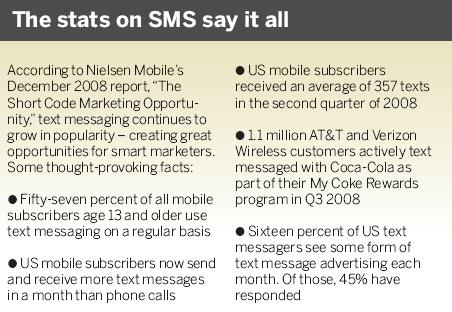
While the mobile Web is a hot topic among US marketers these days, text messaging is not going anywhere. After all, now-President Barack Obama's vice presidential pick, Joe Biden, was announced by text message to an esti­mated 2.9 million mobile users.

In fact, according to the Mobile Advertising Report published by Limbo and GFK/NOP research, text messag­ing (SMS) remains the dominant data service used by US consumers. In the third quarter of 2008, more than 160 million consumers used text messaging, more than in 2007. So it is no surprise that texting campaigns are more ubiq­uitous for marketers across sectors.

“Text campaigns are so appropriate today for marketers with tight bud­gets who are looking at getting back to basics,” says Riccardo Zane, president of Agency.com New York. “Everyone needs to sell, maintain a brand position and deliver ROI. Mobile offers a cut­ting edge opportunity to drive a better bang for a marketer's buck. And texting offers immediacy.”

These days, text is often used in con­junction with other channels such as the Web or in-store signage. For example, Prime Retail, one of the nation's largest developers of outlet malls, recently part­nered with Omnicom's mobile agency Ipsh to complete its first text campaign combined these other channels.

The retail developer used text messaging to promote its “Midnight Madness Pajama Jam,” a special offers promotion that ran on Black Friday from midnight through 8am. The text campaign was promoted by e-mail, direct mail and through in-store and in-mall signage.

Consumers were able to opt in for special blitz offers from participating merchants, which included Polo Ralph Lauren, Michael Kors, Lucky Jeans, Kate Spade, Neiman Marcus Last Call, Hugo Boss, Nike, Saks Fifth Avenue Off 5th, Ecko Unlimited, Gap and Banana Republic Factory Stores, at different times throughout the night.

An example of an offer text was “25% off of your entire purchase at Kate Spade from 12am-2am.” The offers gained intensity throughout the night and encouraged shoppers to visit certain stores to redeem specials in real time.

“Text is more timely and has a stronger call-to-action with immediate offers [than other channels],” says Karen Fluharty, SVP of marketing at Prime Retail. “As a consumer, I know that I get something like 15 e-mails a day and that's great, but it doesn't have the same demand for attention as a text offer does.”

More than 8,000 people signed up to participate in the campaign — 83% of them opted in on the Web; 17% by in-mall or in-store signage. There was a 32% conversation rate for consum­ers who opted in and stayed involved in the program start to finish, and an 85% retention after the final message was blasted to the database.

Interestingly, more than 70% of con­sumers who interacted with the Mid­night Madness program did so over Thanksgiving week from the Sunday prior through the Thursday holiday, and 35% of that came from Thanksgiv­ing Day traffic. All of those who opted in for Midnight Madness will be invited back for similar promotions that are slated to run in 2009.

While text messaging campaigns can attract impressive results, there are also challenges inherent to the channel. Limited character space, the need to capture a consumer's attention with only a few words and the need to be interesting in such a small space can pose issues for marketers.

“It is not rich media — it needs to be specific and text-based,” Zane explains. “Copy doesn't always attract the atten­tion the way that images can. Because you have limited character space, it usu­ally works best when you can tie it into a WAP site, broader Web experience or something offline.”

www.bluespotmedia.ning.com

Mobile Marketing Advantages

With its interactive, measurable, and direct features, mobile marketing represents an enormous opportunity and is fast becoming the marketing channel of choice for organizations of all types.

Mobile Marketing AdvantagesMobile marketing is highly interactive and personalized and has a powerful and immediate impact. By integrating mobile technology into existing communication campaigns, businesses enable their customers to take advantage of special offers, cash in mobile coupons, obtain additional, relevant information and receive alerts about events.

Mobile marketing enables advertisers to send out custom-made and personalized multimedia campaigns to lists of targeted audiences—enabling customers to respond directly. A few of the attractive features of mobile SMS marketing include:

  • Anytime, anywhere communication that is direct and immediate

  • Can be targeted to particular audience groups based on age, profession or gender

  • Cost effective

  • Huge potential for viral marketing as customers tend to forward messages in groups

  • Can be easily integrated in cross-media including TV, print and radio

Advantages of Anytime, Anywhere Mobile Marketing

The highly portable nature of the mobile phone has changed the way people communicate. It makes customers and businesses available to each other anytime, anywhere and transactions can be done 24 hours a day, seven days a week. No more waiting for week days and working hours. This provides a tremendous opportunity for businesses to reach out to customers at critical moments.

www.bluespotmedia.ning.com

Mobile Marketing & LBS: What's Next for Advertisers?

In the early years of mobile marketing, "push marketing" was the big thing whereby the mobile consumer would be happily strolling by his favorite retail store and he would suddenly receive an advertisement on his mobile handset. Of course, frequent buyer programs needed the appropriate privileges, but the idea was perhaps ahead of its time and certainly the handsets were not yet equipped with the technology to derive an approximate location. Plus, five years ago, access to the Internet was spotty and certainly not yet available on cellular phones. Tasks that are routine today were difficult back then.

But this is 2006 and both technology and the consumer have reached a level of maturity that allows different business models to take shape. Zoove Corporation is looking to make it easier to link product information directly with the mobile consumer through "pull marketing." Zoove enables consumers to "dial-up" information directly to their mobile device when prompted for a "call to action." For example, a potential customer is walking past a retail electronics store and sees an ad for the latest iPod. The "call to action" to find more information about the iPod is a number to dial preceded by star-star (**) on the phone's keypad. The number to dial could be: **iPod or **4763. After dialing the number, the customer will receive product information. However, Zoove uses the SS7 protocol that provides information to the marketer about the type of cell phone in use, the carrier, and the location of the customer, in much the same way a 911 call can identify those same characteristics. Thus, the ** dialing sequence enables some key demographic characteristics to be transmitted to the marketer.

So, just as in the early years when marketers found it necessary to include their URL with print, TV or other media advertising, the same may be coming to pass for Zoove-type numbers. Tim Jemison, CEO of Zoove, outlines three primary elements taking place behind the scenes of intelligent networking afforded by the SS7 protocol.
  1. The ability to do handset discovery: when a cell phone user dials the code, the marketer can determine what kind of phone he is using so that the capabilities of the phone are understood and the appropriate text or graphic form can be transmitted back to it.
  2. Display text: the ability to send a text message that barges into the screen to get information to the user.
  3. Location-based services are enabled out of the box: Wireless Access Protocol (WAP) and Short Messaging Service (SMS) short codes can not be used to determine location. However, upon invoking the star-star message, and because the number sequence looks like a regular cellular phone call, all of the information associated with that call is transmitted to the marketer or carrier. The physical location is never revealed and the consumer receives only information relevant to him.
Jemison believes that if you are going to do anything LBS-related, make sure the consumer is in control. According to a study conducted for Zoove by Mediamark Research, " 91% of respondents successfully responded to the ads when instructed to use the star-star call service - nearly double the incidence of SMS short code completion." Zoove's target market is the brand marketer or his advertising agency. It could also be a ringtone or other content provider. Zoove's technology will work with either CDMA or GSM phones, but its focus is on the U.S. for now with trials to get underway in the fourth quarter.

The company'srevenue model can be described as "cost per click" or "cost per call" and they will participate in revenue sharing partnerships. Buying the star-star keyword, however, looks like a battle similar to that of Internet URLs.


www.bluespotmedia.ning.com

T-Mobile and Meru Team Up for FMC

T-Mobile USA and enterprise wireless LAN vendor Meru Networks have teamed up to bring fixed-mobile convergence (FMC) to enterprise customers, using Unlicensed Mobile Access (UMA) technology to let users of T-Mobile devices roam between outdoor cellular infrastructures and indoor wi-fi networks without experiencing any interruption to their calls.
T-Mobile has joined Meru's WINS (Wireless Interoperability and Network Solutions) Partner Program, and the two companies have completed interoperability testing of UMA-equipped T-Mobile devices with Meru enterprise WLANs. The testing verified seamless handoffs between Meru WLANs and the T-Mobile cellular network. The companies have also agreed to conduct joint marketing and sales activities.
The work done by Meru and T-Mobile is designed to let enterprises save on phone costs as increasing numbers of employees use their mobile as their primary work phone. Whenever end users move onto a Meru virtual cell wi-fi network, they no longer eat into the allotted number of minutes in their mobile plan.
Phillip Redman, a Gartner Research VicePresident, who authored the recent report, ‘Enterprise Mobile Phones Will Replace Desktop Phones in North America’, said:
“The number of mobile-phone-only users in enterprises is expected to increase six-fold over the next four years. This means enterprises need to start looking now for ways to increase the efficiency and mitigate the costs of their voice communication infrastructures. One effective means of doing this is to combine in-building wireless voice with external cellular services.”
T-Mobile is the first national carrier with an FMC offering targeted at enterprises, and the first to leverage UMA technology, which provides GSM/GPRS mobile devices with access to Meru enterprise WLANs over unlicensed spectrum bands. T-Mobile's dual-mode lineup includes devices from RIM (BlackBerry), Nokia and Samsung.
In Meru's virtualized WLAN architecture, a single channel is selected for use by all access points enterprise-wide, and a dedicated ‘virtual port’ is assigned to each client device to maximize performance, reliability, and enterprise control over wireless resources.
Additional channels can be layered as more capacity is required. This architecture enables toll-quality voice, assured service quality and traffic classification in converged voice-video-data networks. Meru's technology also offers call admission control, which prevents quality-degrading call overloads by moving new voice calls to alternate virtual cell layers; and location- and application-aware quality of service, which allows assignment of priorities to voice traffic according to enterprise policy.
“Meru's innovative wireless virtualization technology makes it an ideal fit for a venture that bridges the cellular and wi-fi environments,” says Dave Fredericks, National Director for Products,Solutions and Planning at T-Mobile. “UMA technology ensures a seamless experience in moving between networks. Once users move onto the WLAN, Meru's virtualized WLAN architecture guarantees they'll have the same experience as on cellular, because the use of a single RF channel enterprise-wide eliminates handoff interruptions and co-channel interference After seeing how our dual-band phones operate over the Meru WLAN, we are confident that the use of UMA technology will change the nature of the enterprise voice experience.”

www.bluespotmedia.ning.com

Qualcomm quietly buys up Bluetooth experts

C-Net is reporting that last December Qualcomm quietly bought up audio-streaming specialists Open Internet North America, though neither company has made a formal announcement about the purchase.

The deal would make sense for Qualcomm, who have big ideas for the mobile phone as a home-media server which will need high-quality wireless connections to the rest of the home. The company has demonstrated streaming video from a handset to a TV screen, using 3G Femtocell technology, so buying in some Bluetooth and UWB experience would fit well into that strategy.

Open Interface North America (OINA) certainly have those skills, and already provide the Bluetooth stack for the iPhone and, rather more impressively, Logitech's FreePulse headphones. They also have their own, lossless codec for high-quality audio streaming, and have been experimenting with Ultra Wideband ahead of its incorporation into the Bluetooth standard.

Neither Qualcomm nor OINA would comment on the story, but the connection makes sense, as providing Qualcomm with the skills they need if they're really going to make the mobile phone into a media hub. ®


www.bluespotmedia.ning.com

Bluetooth SIG backs Wi-Fi as fast WPAN choices proliferate

Turns to 802.11n

Comment Controlling the technology that will underpin the next generation of fast wireless networks, especially for the multimedia home and HDTV, will be a critical competitive advantage, and the jostling for position is already starting.

IBM and others are putting their weight behind 60GHz options, and the Wi-Fi community is examining gigabit options, but for the nearer term, 802.11n Wi-Fi and UltraWideBand (UWB) are the main emerging options for high speed, short range connections.

UWB wins the day on performance and low power usage, provided distances are kept short, but with the once tortured 802.11n standards process now approaching resolution, UWB is in danger of falling behind in terms of commercial availability.

This is because of two factors – although several regulators, including those in the European Union, US, and Japan, have now opened up to UWB, there are many more decisions to be made before it becomes universal like Wi-Fi; and there are now some doubts over its actual performance in commercial platforms, which could delay the volume commitment from chipmakers and OEMs that is required to achieve the brutally tight economics of embedded personal area wireless.

Bluetooth over Wi-Fi

One sign that fast Wi-Fi is edging ahead of UWB in time to market terms is a decision by the Bluetooth Special Interest Group (SIG), which controls the short range, mid-speed standard, to create protocols that will enable Bluetooth to use Wi-Fi as a transport.

The SIG had previously committed to developing its proposed high speed option using UWB – and specifically, the WiMedia standard implementation backed by most of the PC and consumer electronics sectors – as the transport, but now wants to offer an 802.11n choice as this is making better progress in getting into handsets (though currently in a pre-standard version).

This is presented by the group as a stopgap option before their first choice is fully launched, but if Bluetooth over Wi-Fi is widely adopted, that may shrink, or at least delay, the addressable market for a UWB version, except in applications that require extremely high speeds.

"We have got to be realistic," said John Barr, chairman of the SIG's board of directors, and director of standards realisation at Motorola. "UltraWideBand silicon vendors are not delivering anything close to what they have promised."

He told the Bluetooth Evolution conference in London last week that Motorola had shifted its focus because of UWB delays and is seeing rising demand for Wi-Fi in mobile devices. Since Motorola has not taken a major role in the WiMedia Alliance, whose technology was originally opposed in the standards bodies by a rival from former Motorola chip unit Freescale, it may also see 802.11n as an option over which it can have more influence.


www.bluespotmedia.ning.com

Bluetooth's coming home

Footy fans at a number of clubs will soon be able to enjoy adverts downloaded direct to their mobile phones over a Bluetooth connection, courtesy of promotional company Bluepod.

Fans at Blackburn Rovers, Birmingham City, West Ham, Portsmouth, Wigan Athletic, Wolves, and Celtic will be able to opt in to receive transmissions, which will come in the form of video and audio as well as text messages, and include information about club fixtures and club profiles along with advertising.

Bluepod reckons that fans hanging around on the terraces are an ideal target for entertaining advertisements, and cite a recent trial at Portsmouth that saw over 6,000 fans downloading a movie trailer from a crowd of about 20,000.

Given that advertisers will, apparently, pay between 40 and 70 pence per download, that's not a bad day's work for Bluepod.

The content comes from tiny servers, called Bluepods, which just connect to the mains and get their updates wirelessly. Bluepods have already been installed in Vue, Cineworld and Showcase cinemas, and were used with great success to promote LG's Viewty phone.

To receive the content punters obviously need a Bluetooth phone which also needs to be visible, so installations are accompanied by enormous posters suggesting people get that set up to opt into the service. ®


www.bluespotmedia.ning.com

Info chief shrugs off Bluetooth regulation

The Information Commissioner will no longer regulate the use of Bluetooth mobile technology, prompting fears of a wave of "Bluetooth spam".

The commissioner no longer considers the wireless connection technology to be covered by the UK's privacy laws.

The Information Commissioner's Office (ICO) upholds the Privacy and Electronic Communications Regulations (PECR), which control the sending of unsolicited marketing messages. That prohibition will now not extend to Bluetooth technology, the ICO has said in correspondence with someone who enquired about the regulations.

The ICO had not commented officially at time of publication. It is expected to update its guidance this week on the matter.

"A public electronic communications network means an electronic communications network provided wholly or mainly for the purpose of making electronic communications services available to members of the public," said the correspondence.

"Regulation 22 therefore applies to the sending of text messages or emails (which are both sent over a public electronic communications network), however, following consultation and consideration we do not believe that this definition covers Bluetooth technology.

"Our guidance will therefore be updated to reflect the fact that we do not consider Bluetooth marketing falls under the provisions of Regulation 22 (and therefore does not fall under the Privacy and Electronic Communications Regulations)," said the correspondence.

"It is going to be a complete free for all," said Troy Norcross, a mobile marketing consultant with New Media Edge. "I call it blue spam for a reason."

The ICO guidelines have until now insisted that users opt in to receive Bluetooth marketing in the same way that they have to with other forms of communication. That now will change.

"Until now most businesses have opted for a soft opt in, so a cinema says that by being in our building you are seeking to do business with us, so we can send you material relating to films," said Norcross. "But if they started sending you material about insurance or lawnmowers that would no longer count. It has to be related to their business."

Norcross said there were examples of uses of Bluetooth which went against the guidance already, but that they have gone largely un-noticed. "The people doing this around town or in bus shelters are doing it ostensibly against the rules, but not in enough numbers to get people really up in arms."

This, he said, was likely to change. "I think now we are going to find Bluetooth marketing suppliers grabbing on to this and going out and trying to get more people to try Bluetooth marketing."

Bluetooth is a close-range wireless communications technology present in many mobile phones. Users can avoid receiving marketing messages by switching their Bluetooth off or by setting their phones to refuse connections from strangers, but this would affect the way they can use the technology.

www.bluespotmedia.ning.com


Bluetooth marketing window could be shut

A window of opportunity for marketing by Bluetooth technology that opened in October could be closed once more, the UK Government has said.

Definitions in privacy regulations are being checked, stakeholders are being consulted, and the law could change.

Bluetooth is a standard that lets devices share data wirelessly. Most Bluetooth-enabled mobile phones can only detect other Bluetooth-enabled devices within a few square metres; but some devices can "broadcast" to devices up to 100 metres away.

The technology presents an obvious marketing opportunity: advertising hoardings and premises can transmit messages using Bluetooth and all enabled devices within range will receive the message. You could walk past a restaurant and receive a "buy one meal, get one free" offer on your phone – without the restaurant knowing your number.

Until October, though, there was confusion over how to do that in a way that is compatible with the Privacy and Electronic Communications Regulations. These regulations restrict unsolicited marketing. They came into force in 2003 when far fewer consumers had Bluetooth-enabled phones than have them today.

At the time, guidance from the Information Commissioner's Office (ICO) said the regulations did apply to Bluetooth. That made Bluetooth marketing almost impossible because the regulations effectively require prior consent – and prior consent for Bluetooth marketing is almost impossible to obtain in any practical way. The ICO announced a new interpretation last month.

In a statement, the ICO said: "Following discussions with the Department of Business, Enterprise and Regulatory Reform [DBERR] and others the Information Commissioner’s Office has amended its guidance on the Privacy and Electronic Communications Regulations 2003.

"The guidance previously stated that marketing messages sent using Bluetooth technology would be subject to PECR rules relating to the sending of unsolicited marketing," it said. "However, the regulations only apply to messages sent over a public electronic communications network and we have concluded that Bluetooth messages are not in fact sent using such a network. We have amended our guidance accordingly."

The ICO added: "It is for government to decide whether the law should be changed to cover such marketing."

Yesterday, DBERR told OUT-LAW: "The department wishes to work with the European Commission during the review of the Privacy and Electronic Communications Directive to find the best way to evolve the current rules.

"We will be looking to ensure that definitions are suitable for new technological developments in communications technology. We will speak to stakeholders to gauge the size of the problem in relation to Bluetooth and will discuss, in the context of the review, any changes with them," it said.

The European Commission proposed amendments to the directive (41 page/245KB) on 13 November. These amendments will not affect Bluetooth marketing.

Struan Robertson, editor of OUT-LAW.COM and a technology lawyer with Pinsent Masons, said there is currently an open window of opportunity for marketers.

"I can't imagine that DBERR will find a problem with Bluetooth marketing right now because it's pretty rare. That may not be down to the regulations, of course. It could be that marketers just don’t want to use the medium. Still, anyone who does want to use Bluetooth marketing seems to be legally safe for the time being."

"There are commercial issues with Bluetooth marketing, though," said Robertson. "People will get really annoyed if a shop that they pass every day on their way to work is constantly broadcasting an ad to their phone. So hopefully the uses will be a bit more creative than that."


www.bluespotmedia.ning.com

What Is Bluetooth Marketing?

Author: Zalim Nastaev


Article Tools:


As another innovative way to complement traditional marketing techniques along came Bluetooth marketing. This new concept has been in practice for not so long, and needs to get more attention from the consumers and marketers to start evolving in more or less significant scales.

We aim in this brief article to disclose the basic features and trends of Bluetooth technology as a marketing communication tool, so the consumers should be made aware of the technology, and improve their thinking of it, or make it even more negative, if you like.

The Rise of Bluetooth

Bluetooth appeared as a result of the work of a development group consisting of the representatives of several telecom giants: Ericsson, IBM, Intel, Toshiba and Nokia. These companies combined their resources to create a unified technology for wireless connection of mobile devices. Some time later the group working on the project (The Bluetooth Special Interest Group – the Bluetooth SIG) expanded, companies like 3COM/Palm, Axis Communication, Motorola, Compaq, Dell, Qualcomm, Lucent Technologies, UK Limited, Xircom entering the group. Today, the group combines the efforts of as many as over 4000 companies working on the development of a free and open specification of Bluetooth. This unified work has created the main advantage for Bluetooth – it is now supported by most of the mobile devices that are produced nowadays. Another advantage when compared to, say, IR signal, is that the users can exchange data through radio waves without setting a direct visible contact. Today, penetration of Bluetooth into mobile phones in EU, for example, is at a rate of 35% – 42%, while up to 2008 it is expected to rise as high as 80%. 2006 was the year that Bluetooth Penetration reached the One Billion mark. IDC forecasts that by 2007 more than 433 million Bluetooth devices will ship worldwide, which is an estimated market penetration of 74 percent. Bluetooth Location-based media distribution also took a major step forward.

The Rise of Mobile Marketing

In that early period of initial development of the technology nobody would have thought of using Bluetooth as a marketing tool. Traditional media were striving and dominating the marketing communications, while various viral campaigns were just taking their first steps. However mobile technology was taking a rapid growth and along came agencies offering mobile as an alternative media to TV, radio and print. The growth was so fast that the penetration level of mobile channel has exceeded the Internet. Thus, the advantage that the mobile advertisers could use was the reach to the end consumers. But the major advantage was, of course, the targeting opportunities – the personal nature of the mobile devices became a grand, long-awaited opportunity to develop personalized communication programmes, and the two-way nature of mobile channel gave the opportunity to create the interactive communications, where the response of the communication target is valued even higher than the messages originated by the advertisers.

Some opponents would argue that the mobile marketing is just another threat of spamming – none can be assured that the companies would not start sending out messages of no interest to every single mobile user who has no interest in their services. Do they make sense? On the first glance, this threat is possible. However, let’s look at this problem from a company’s viewpoint. None knows how much time and how many efforts brands allocate to create a positive image with the customers. And everybody knows that this image can be spoilt in just one minute - just a trifle, small mistake, and the rumours go viral. Next day you have to start all over again. The brands do realize the danger of delivering messages to mobile users without any system. The mobile marketing players have learned the lessons of its elder brother – Internet and email. The Mobile Marketing Association and a number of other bodies were established to consolidate the mobile industry players. The latter are in close contact with each other, discussing the issues arising during their activities. This consolidation and collaboration has changed the traditional way we look at the industries: and this way has the name – mobile players are working within the so called ecosystem, where technology and content providers, brands and agencies, aggregators and operators work in close collaboration to stimulate the growth of the industry.

What is more, mobile devices are always on, which makes the consumers reachable no matter where they are – they need no access to TV sets, Internet or whatever else – you name it. One more: the mobile campaigns proved to create much higher response rates. Finally, the mobile marketing programmes were so much less costly to create. Seeing all these advantages, many marketers started turning their attention to this sphere.

Bluetooth Marketing as it is

Alongside with the mobile marketing (which basically includes text and MMS messaging, content delivery, mobile internet and mobile video) the agencies and brands have started to show some interest in using Bluetooth as a communication tool. This sphere, however, has not been developing as fast, due to the ambiguity of implementation of Bluetooth marketing campaigns.

The Bluetooth marketing practice that has been implemented by various agencies so far gave rise to rather agitated discussions. The supporters of Bluetooth marketing are attracted by the fact that they receive location based and time-relevant information, discounts that can be used right the moment they are provided, and, unlike with mobile marketing, the communication is cost-free for both advertisers and the audience. Their opponents argue that all the obvious advantages will offset one major drawback: bluecasting is intrusive and annoying, and people will hate receiving unsolicited messages delivered to their mobile phones. In the end, this way of “push” bluecasting can be perceived as something as dangerous as “bluespamming”.

Naturally, both the sides make reasonable points, and this new media, just as sms marketing, demands increased cautiousness from the marketers. The latter should not be tempted by this cheap opportunity and spam all the passers-by with the standard messages. In the end it is personalization that is the most advantageous criterion of location based services, and sending the same message to everybody passing by is the way to become an aggressive intruder into people’s privacy. Since the legislation has not been fast enough to catch up with the development in the wireless sector, players in some industries (as, for instance, mobile marketing) have consolidated to introduce the necessary regulations to stimulate continued growth. Just for the same reasons caution has to be taken, and certain reasonable regulations must be imposed on the players in Bluetooth marketing sphere to prevent the aggressive image of this young industry and make it more positive in the eyes of the mobile users, which will in the end benefit all the participants.

Security

Another major idea hindering the development of Bluetooth communication is the security concerns. Although this is the area where the SIG group has focused its most resources (and especially with the mobile phones), the people are not ready yet to accept the idea of absolutely secure Bluetooth communication in the public places. To a certain extent the pessimists have their reason to be pessimistic. However, those who follow the simple rules of using Bluetooth in public, should not be worried of being put to danger of receiving harmful files.

The thing is that the mobile producers have found the ways to prevent all sorts of “hidden” attacks from all kinds of violators: bluejackers, bluesnarfers, bluebuggers. Today, only the older models can be hacked without the users knowing and giving authorisation to connect to their phones. This means that a mobile user can control his communication process – whether he/she wants to accept or cancel the connection – it is up to an individual user to decide.

I do advise to keep one’s Bluetooth off or at least in the “hidden” mode as long as he/she is not intending to send or receive files. And I do advise the advertisers to not narrow their communications to solely Bluetooth channel. The latter should be accompanied by a traditional media (say, outdoor posters inviting passers-by to turn their Bluetooth on to receive a beneficial offer). Thus, the user knows exactly when the necessary communication may start, and who the sender is.

Business Models

Let’s have a look at what we have observed so far in this industry:

A number of Bluetooth marketing agencies have appeared on the market to fill in the demand on the location based services. To offer their services to the customers the agencies have chosen several types of business models which, along with the advantages in the face of the competition, have certain drawbacks which hinder the development of the industry and the growth of demand.

• The first business model is the pure selling of the Bluetooth communication devices. This option allows marketers to send out specific messages to the passers-by. This model is meant for the smaller businesses that show their interest in integrating Bluetooth channel to their overall communication strategies. Small companies are budget-sensitive, therefore, they can be attracted by the perspective of minor investments into the communication process. Besides, this communication will allow to more efficiently track the ROI – the opportunity to track the number of messages sent and the number of visits prompted by the messages.

There is a major disadvantage that we can predict for the customers within this business model. This is a purely push model, and there is no chance for the company to send targeted messages. If a company in, say, a retail business starts sending out messages to passers-by, there will be a certain percentage of the receivers annoyed by being disturbed. This intrusiveness cannot be prevented in any efficient manner with this push-based model. Therefore, marketers should be careful using Bluetooth communications this way. One way out is to offer very significant rewarding to the receivers, which is never efficient for budget-sensitive companies. On the other hand, companies in some specific industries will feel more or less free to send out messages to the audience (e.g. sending various information messages to participants of a conference, since the audience is supposed to have similar interests in certain spheres). To some extent the outdoor and print advertising warning people about Bluetooth communication area would help both in lowering dissatisfaction by intrusiveness and increasing the reach to the customers by prompting them to switch the Bluetooth signal on to receive certain beneficial messages.

• Another business model offers full outsourcing of Bluetooth communication campaigns. This means that the agencies allocate their resources to design complete Bluetooth communication programmes for the client to integrate them into the overall communication strategies of the brands. This model is advantageous for the bigger businesses that find financial resources to outsource communication campaigns to experts while concentrating their own resources on their core competencies. In this case I would advise the brands to be careful selecting their partners for this type of communication.

To conclude the above text, I believe that Bluetooth, with its certain advantages, needs some time to accept the shape that will convince the sceptics to try it out along with the today’s supporters of the service. And I know that this moment is not too far off now. This has to become a trend – in the end both the consumers and the brands have been longing for the opportunity to provide and to receive the services they need – exactly where they need them and when the need them. Bluetooth communication has to become interactive, personal and secure for people to unanimously accept it. The industry has not yet been ready to meet this combination but I believe that with the technology development it is just a matter of time - little time…

www.bluespotmedia.ning.com

HOT Mobile Marketing (Innovation 604 Inc. & BlueSPOTmedia)